
Air recirculation turbulators
What is an air recirculation turbulator?
An air recirculation turbulator (also known as an air circulation fan, destratification fan or horizontal airflow fan, HAF) is an axial fan mounted in a cylindrical or conical housing and suspended from the load-bearing structure of the building. Unlike supply or exhaust fans, which exchange indoor air with the outside environment, a turbulator operates in a closed loop: it draws air from one part of the room and discharges it at a defined velocity in another direction, creating a directed air jet. By carrying the surrounding air along with it (the so-called jet entrainment effect), a single unit can set in motion an air mass 10–20 times greater than its nominal capacity.
The name “turbulator” comes from the fact that the device makes the airflow turbulent, i.e. it breaks up the calm, stratified (laminar) state of the air and forces layers of different temperature and humidity to mix. Three main designs are found on the market: horizontal-flow turbulators with a cylindrical housing, vertical-flow destratifiers that push warm air down from the ceiling zone, and large-diameter (3–7 m) low-speed ceiling fans (HVLS – high volume, low speed), which are used in production and logistics halls. In greenhouses, horizontal-flow fans have historically dominated, but over the past decade vertical-flow turbulators developed specifically for greenhouses have been used increasingly widely – for example, the Doll Turbulator® DV8000 from the German manufacturer Doll Wärmetechnik GmbH, which uses a vortex-like (radial-helical) air movement to bring heat from the roof zone down to the plants, rather than merely moving it horizontally.
The physical basis: thermal stratification
Warm air is lighter than cold air, so it rises by natural convection and accumulates under the roof, while cool air settles at floor level. This phenomenon is called thermal stratification. In an unmanaged tall space, the temperature gradient is typically 0.5–1.5 °C per metre of height, and in a 10 m high warehouse the difference between floor and ceiling can reach8–12 °C. This means several negative effects at once. First, heat is stored where nobody needs it, and it is lost to the outside through the roof structure, whose area in large buildings is enormous – heat losses through the building envelope are proportional to the temperature difference between inside and outside. Second, in order to reach a comfortable temperature in the working zone (0–2 m above the floor), the heating system is forced to operate at a higher output. Third, humidity and gases (for example, CO₂ in greenhouses or fumes in production facilities) are also distributed unevenly.
Turbulators solve this problem by mechanically mixing the air layers. Continuous air movement at a velocity of 0.2–1 m/s is sufficient to reduce the gradient to 1–2 °C over the entire height. It is important to understand that a turbulator neither generates nor removes heat itself – it only redistributes what is already in the room. However, it is precisely this redistribution that allows the heating system to operate at a lower setpoint temperature and with lower losses, which in practice yields heating energy savings of 10–30 %, depending on the height of the room and the quality of the roof insulation.
The effect of air movement on heat and mass transfer
The second physical mechanism that makes turbulators valuable is the reduction of the boundary layer. Around any surface – a plant leaf, a human body, the packaging of a frozen product or the housing of a machine – a thin layer of air forms in still air, acting as an insulator and slowing the exchange of heat, water vapour and gases. Air movement disrupts this layer: the heat transfer coefficient at a flow velocity of 0.5 m/s is roughly twice as high as in still air. In a greenhouse this means more intensive transpiration and CO₂ uptake; in a production facility, better cooling of equipment and greater comfort for workers; in a warehouse, faster equalisation of product temperature.
Application in greenhouses
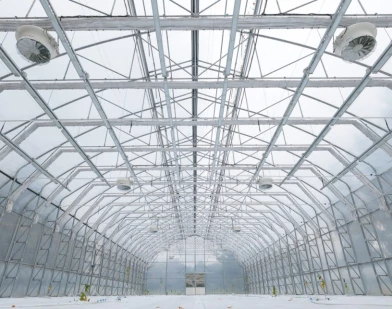
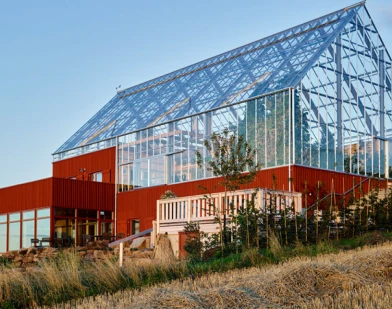
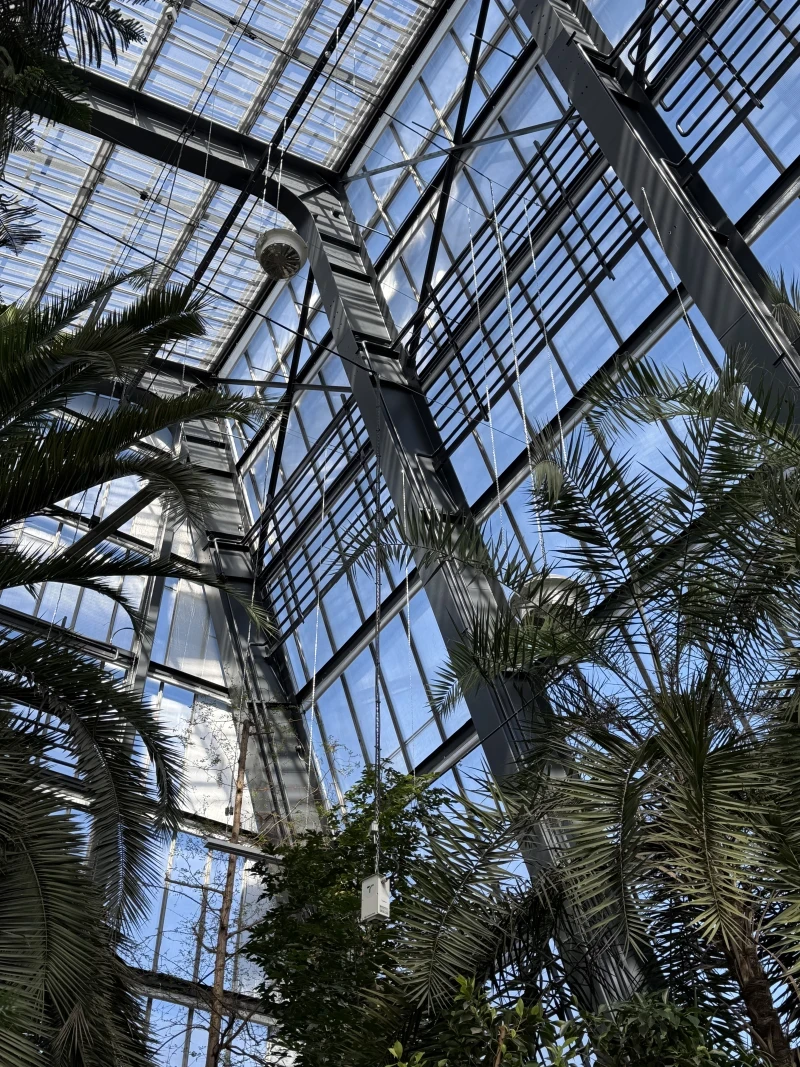
In greenhouses, air circulation is one of the fundamental components of microclimate control, alongside heating, ventilation, shading and CO₂ supply. Greenhouses are a special case in this respect: because of the physiological needs of plants, the covering must be light-permeable, so a greenhouse cannot be insulated in the same way as a residential or industrial building, and heat losses through the covering are considerably higher than in other structures. The warm air rising from the plants and heating pipes forms a so-called “warm air cushion” under the roof or the energy screen, which directly increases losses, while at the bottom, at plant level, the temperature remains lower and uneven. This is precisely why heating costs make up the largest share of total operating costs in greenhouses, and precisely why air recirculation carries the greatest economic weight here.
The horizontal airflow (HAF) principle, developed in the 1950s by the Connecticut Agricultural Experiment Station in the USA, involves arranging several fans in rows 40–60 m apart along the length of the greenhouse, with the adjacent row pointing in the opposite direction, thus creating a closed, circular air movement across the entire greenhouse floor plan. Maintaining such an “air carousel” requires little energy, since once the air mass has been set in motion, it only has to overcome friction. However, horizontal flow solves the stratification problem only partially – it equalises the temperature at plant level but does not recover the heat that has accumulated in the roof zone. Vertical-flow turbulators such as the DV8000 have been developed precisely for this task: the unit, with a diameter of 830 mm and an airflow of up to 8,000 m³/h, operates within a radius of up to 12 m (working zone diameter 24 m) and uses a vortex-like movement to bring warm air down from the ceiling zone without creating draughts or drying out the crops.
An essential feature of modern turbulators is the reverse function. The DV8000 can be switched between downward flow (heat recovery mode in winter) and upward flow, which in summer expels warm air through the roof ventilation and additionally cools the plants, while in winter, by blowing warm air against the roof, it promotes snow melting and relieves the greenhouse structure of snow load. The speed and air volume in both directions are steplessly adjustable via a 0–10 V or PWM signal from the climate computer, which allows the unit to be precisely adapted to the season and the specific microclimate situation.
The agronomic benefits are numerous. A uniform temperature across the entire greenhouse area ensures an even rate of plant development, which is important both in vegetable production (tomatoes, cucumbers, lettuce) and in the cultivation of flowers and young plants, where a uniform yield and a defined harvest date are economically decisive. Air movement prevents the accumulation of cold, humid air within the plant canopy and at floor level, where relative humidity at night can reach 95–100 %. Under such conditions, dew condenses on the leaves, which is the main precondition for the development of fungal diseases – grey mould (Botrytis cinerea), powdery mildew and leaf spot. Constant airflow keeps the leaf surface dry and reduces the need for fungicides.
In terms of photosynthesis, air movement replenishes CO₂ directly at the leaf stomata. In still air, the CO₂ concentration around an intensively photosynthesising canopy can drop 100–150 ppm below the ambient level, which directly limits growth. Turbulators continuously replace this depleted layer, which is particularly important in greenhouses with CO₂ enrichment, where every kilogram of gas supplied costs money. Moderate air movement also promotes transpiration and, with it, the transport of nutrients (calcium, boron) to the growing leaves and fruits, which reduces physiological disorders such as blossom-end rot in tomatoes.
During the winter heating period, turbulators work together with pipe heating, equalising the temperature between the heating pipes and the tops of the plants and preventing heat from accumulating under the covering, where it is quickly lost. In summer they complement ventilation: when the vents are open, horizontal flow helps to distribute the incoming outside air more evenly. Turbulator operation is usually controlled by the climate computer, which switches them on based on temperature or humidity sensor readings or on a time schedule. The heating savings observed in practice in greenhouses are 10–20 % with horizontal-flow systems, while for vertical heat-recovery turbulators the manufacturer’s thermographic measurements in greenhouses of various types show heating energy savings of up to 30 % during the winter period, depending on the greenhouse design, the type of heating system and the operating regime. The savings arise not only from lower losses through the roof, but also from the fact that the moment at which the heating system switches on is delayed, because the warm air cushion is put to productive use. In the case of the DV8000, this performance is confirmed by independent CFD flow modelling and thermographic measurements (Ingenieurbüro Merkle & Partner, Heidenheim), and in 2013 the technology received the German Innovation Award for Horticulture (Deutscher Innovationspreis Gartenbau).
Application in warehouses
Warehouses are the classic example of destratification: tall (8–15 m and more), spacious buildings with a relatively small number of internal heat sources, in which the working zone is located only at floor level. Without air recirculation, the heating system effectively heats the upper part of the building, while people and goods are in the coldest layer. Vertical-flow destratifiers suspended below the ceiling and blowing warm air downwards, or large-diameter HVLS fans, make it possible to reduce the temperature gradient to 1–2 °C, which in turn allows the heating setpoint temperature to be lowered by several degrees without compromising comfort.
The second essential aspect is condensation. When warm, humid air comes into contact with cold metal structures, the roof covering or cold goods brought in from outside, condensation forms on them, damaging cardboard packaging and promoting corrosion and mould. Air movement equalises temperature and humidity and allows surfaces to dry. This is particularly important in the storage of food, paper, timber, furniture, textiles and electronics, where manufacturers’ requirements often specify a defined relative humidity range (usually 40–60 %).
In cold stores and refrigeration chambers, turbulators work in the opposite direction – they distribute the cold produced by the air coolers evenly and eliminate “warm pockets” between the rows of racking, thereby ensuring a uniform product temperature and reducing compressor running time. In vegetable and fruit stores, uniform air movement of around 0.1–0.3 m/s is one of the standard requirements of storage technology.
Application in production facilities
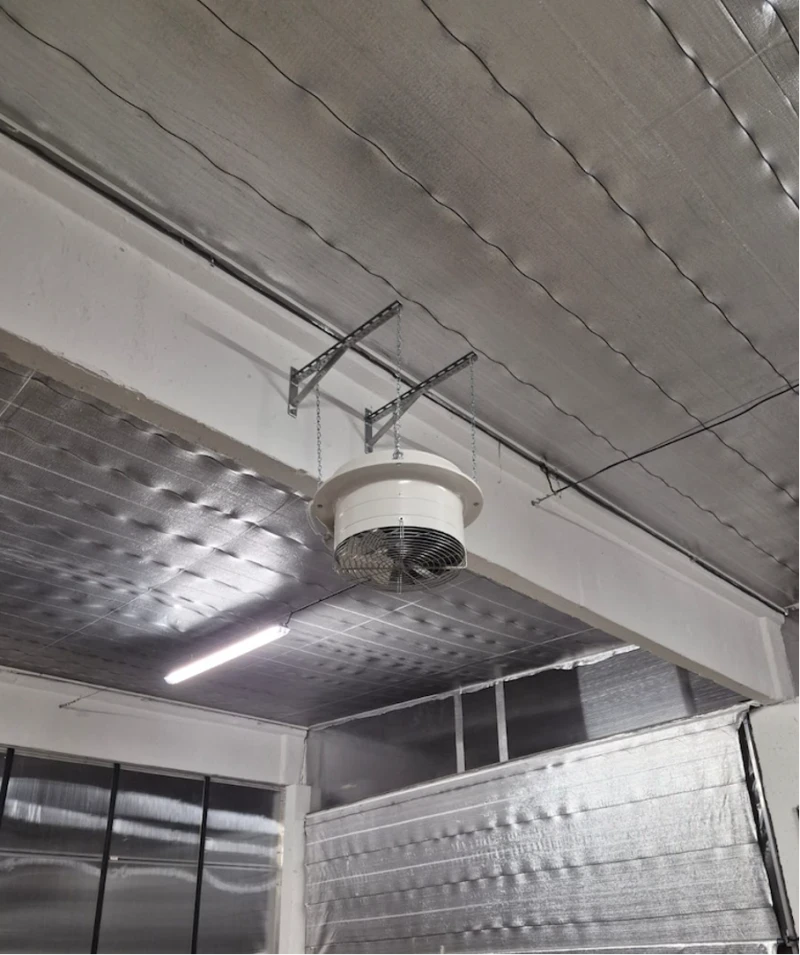
In production halls the situation is more complex, because the space contains many local heat sources – motors, compressors, furnaces, welding equipment, lighting – and workstations of varying intensity. Here, turbulators fulfil several functions. In winter, as in warehouses, they equalise stratification and allow the heat zones around machinery to be used for heating the entire space; in many production facilities, the heat emitted by equipment, when properly distributed, substantially reduces the need for additional heating.
In summer, turbulators improve the thermal comfort of employees. Air movement at a velocity of 0.5–1.5 m/s creates a subjective cooling effect equivalent to a 2–4 °C lower temperature, even though the actual air temperature does not change – this is the mechanism of accelerated evaporation and convection that underlies the so-called wind chill effect. This often makes it possible to postpone or entirely avoid the installation of expensive air conditioning systems in large halls, where cooling the air to a comfortable temperature is not economically justified.
Turbulators also improve the efficiency of the existing ventilation system: supply air from a few diffuser locations is distributed more evenly throughout the room, and local fumes or dust are diluted and carried towards the extraction zones. It should be noted, however, that in rooms with hazardous fumes or dust, air mixing must be coordinated with the local extraction system so as not to spread contamination throughout the room, and in potentially explosive atmospheres, equipment of the appropriate ATEX category must be used.
Equipment selection and design
The design of a turbulator system begins with an analysis of the room’s volume, height and layout. Several guideline values are used in practice. For greenhouses, the recommended capacity is approximately 2–3 m³/h per square metre of floor area, which is delivered by typical HAF fans with a diameter of 30–60 cm and a capacity of 2,000–6,000 m³/h, spaced 40–60 m apart within a row and 10–15 m between rows. For warehouses and production halls, destratification aims for 1–3 complete room volume changes per hour (in recirculation, not with outside air); one destratifier typically serves 100–300 m² of floor area depending on the height, while an HVLS fan with a diameter of 6–7 m serves up to 1,500–2,000 m².
The power rating of the units is low: greenhouse turbulators consume 50–250 W, destratifiers 100–300 W, and HVLS fans 500–1,500 W, while moving considerably more air than conventional fans with the same energy consumption. The motor type is of major importance. Units with EC (electronically commutated) motors allow stepless speed control and consume many times less electricity than traditional ceiling fans with AC motors: the DV8000 with its high-efficiency EC motor (Doll-EK technology) consumes only approximately 30 W (0.13 A) at 50 % speed, which is the typical operating mode, compared with approximately 400 W consumed by a comparable AC fan; at 4,000 operating hours per year, this amounts to around 1,480 kWh, or around €300 in savings per unit (at €0.20/kWh). In humid, aggressive environments (greenhouses, food production facilities), the protection rating of the housing and motor is important (at least IP54, ideally with an additional motor moisture protection system), as are a wide operating temperature range (DV8000: from –25 to +60 °C) and corrosion-resistant materials. When designing a vertical-flow turbulator system for greenhouses, a guideline planning value is approximately 140 m² per unit; several manufacturers offer free individual layout planning.
When positioning the units, it must be ensured that the air jet remains free of obstacles – luminaires, structural elements, shading screens, racking – and that it is not directed at people or sensitive plants at velocities above 1 m/s for prolonged periods. Control should preferably be integrated into the building management system or climate computer, using temperature sensors at different heights: the difference between the ceiling and floor sensors is a simple and clear switching criterion.
Economic and environmental aspects
Turbulators are among the energy efficiency measures with the shortest payback period. The cost of the equipment is low and installation is simple, while heating savings of 10–30 % in large buildings mean thousands of euros per season. The economic effect is well illustrated by a sample calculation for a medium-sized 1 ha (10,000 m²) greenhouse. Assuming a heat energy consumption typical for the industry of around 350 kWh/m² per year, total consumption is around 3,500 MWh, which at a heat energy price of €0.06/kWh means approximately €210,000 in heating costs per year. Such an area requires around 72 DV8000-type turbulators (with a working zone of ~140 m² each). At 30 % heat energy savings, this yields up to €63,000 per year, from which the electricity consumption of the turbulators themselves must be deducted – 72 units × 30 W × 4,000 h ≈ 8,640 kWh, or around €1,700 per year. The net savings are therefore approximately €61,000 per year. The payback period is calculated by dividing the total investment cost by the annual net savings, and even at relatively high equipment and installation costs it usually falls within 1–3 years. It should be emphasised that these figures are illustrative: an accurate calculation requires the data of the specific greenhouse – the heated area, the actual heat energy consumption in recent periods, the energy tariff, as well as an individual equipment layout plan and a commercial offer.
Additional benefits that are harder to express in money, but which in practice are often even more important, include a higher and more uniform yield in greenhouses with less variation in growth, healthier and visually more attractive produce with lower losses at the point of sale, fewer damaged goods in warehouses, fewer diseases and consequently lower consumption of plant protection products, as well as better working conditions. Reduced heating energy consumption also directly means lower CO₂ emissions, which is significant for companies participating in energy efficiency support programmes or reporting on their climate impact.
Air recirculation turbulators are not a substitute for heating or ventilation, but rather a complement that allows existing systems to work more efficiently. Their operation is based on simple physical principles – the elimination of thermal stratification and the reduction of the boundary layer – yet the benefits are many-sided: energy savings, a uniform microclimate, healthier plants, safer storage of goods and more comfortable working conditions. Regardless of the type of heating system, turbulators are one of the most cost-effective energy efficiency measures in both new and existing buildings, and modern units with EC motors and a reverse function extend their application to summer ventilation and the reduction of snow load as well. A correctly selected and positioned system is one of the most rational investments in any tall, spacious building in which air quality and temperature affect the production result; the first step towards it is an individual layout plan and a commercial offer, which make it possible to specify the number of units, the investment amount and the specific payback period.
SIA “TERMOLAT” is one of the largest builders of professional greenhouses and installers of technical equipment in the Baltics and the official supplier of Doll Turbulator® equipment in Latvia. We provide the full cycle – from site survey and the development of an individual equipment layout plan to the delivery of the turbulators, their installation and integration into the existing climate control system. For each site we prepare a calculation based on your actual heated area, heat energy consumption and energy tariff, so that you know the expected savings and the payback period of the investment before making a decision.
Contact us for a free consultation, site survey and commercial offer: info@termolat.lv