Solar park efficiency: Why is rain alone not enough?
Degradation of Photovoltaic (PV) Systems and the "Soiling" Effect
In scientific literature, the term soiling refers to the accumulation of dust, dirt, and other particles on the surface of PV modules. Although it may seem that rain is frequent in Latvia, it is simply not enough. Research indicates that even a small, visually subtle layer can cause significant energy losses.
Scientific Facts on Efficiency Loss:
- Spectral Filtration: Dirt does not just block light; it alters its spectrum. Studies show that a layer of dust primarily absorbs short wavelengths (the blue part of the spectrum), which are critically important for the operation of modern silicon panels.
- Hot Spots: Uneven contamination, such as bird droppings or dried leaves, creates localized shading. This leads to cell overheating, which can irreversibly damage the panel structure and reduce its service life by 5–10 years.
- “The Yellow Spring”: A specificity of Latvia is pine and birch pollen. These are sticky and form a hydrophobic layer, to which industrial soot and road dust then adhere more easily.
Why DJI Agras T50 Outperforms Manual Cleaning
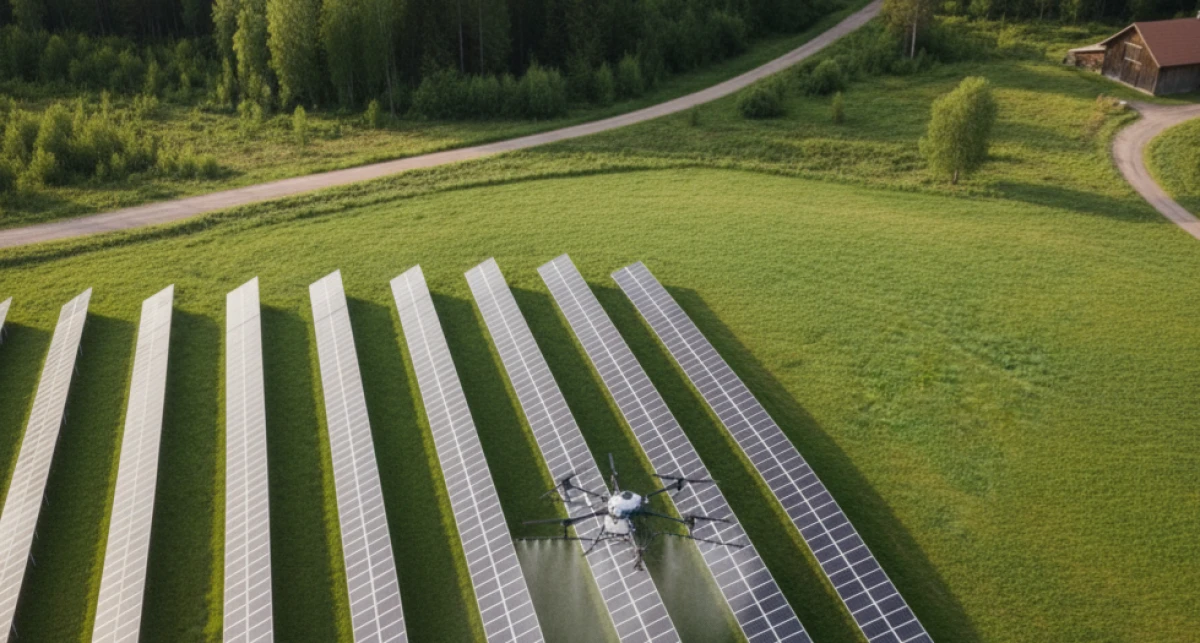
Traditional panel cleaning with brushes and water jets carries several risks, which SIA TERMOLAT addresses with contactless drone technology.
Mechanical Stress and Microcracks
Panels consist of fragile silicon wafers protected by tempered glass. However, walking on structures or the mechanical pressure of heavy brushes creates microcracks. Initially invisible, these expand due to temperature fluctuations, causing a loss of conductivity. The T50 drone provides complete contactless treatment, eliminating any physical pressure.
Preservation of Surface Nano-Coating
Most modern panels have a special anti-reflective and self-cleaning coating. Aggressive friction with brushes wears this layer down within 3–5 years. By using the VitaPanel Eco solution applied with the drone's atomized spray system, the surface is protected while even the most stubborn organic deposits are chemically dissolved.
VitaPanel Eco:
The solution we use is not just a cleaning agent. It is a composition developed for several purposes:
- Anti-static Effect: After treatment, the panel surface becomes less statically charged, meaning airborne dust no longer adheres as actively.
- Optical Clarification: The substances in the composition help fill micro-irregularities in the glass surface, theoretically improving the light refraction coefficient and increasing the volume of kWh produced immediately after treatment.
- Ecological Safety: Since solar farms are often located on agricultural land, VitaPanel Eco is fully biodegradable, without affecting groundwater or biodiversity under the panel rows.
Economic Justification: Latvia's Specifics and Real Figures
Latvia's climatic conditions create a unique challenge: we do not have pronounced sandstorms like in the south, but we have high humidity combined with biological pollution. This means that dirt on the panels does not just sit there but "bakes on," creating a microscopic film.
How high are the average losses in Latvia?
According to local energy audit data and monitoring station measurements, unmaintained solar panels in Latvia lose an average of 8–12% of their theoretical power per year. During the spring pollen season and autumn leaf fall, this figure can temporarily reach as high as 20%.
Panel Lifespan: Maintained vs. Unmaintained
The longevity of solar panels depends not only on the silicon cell itself but on the integrity of the entire module structure.
| Metric | Without Regular Care | With Professional Maintenance |
|---|---|---|
| Effective Lifespan | 18–22 years | 25–30+ years |
| Degradation Rate | ~1.2% - 1.5% per year | ~0.4% - 0.5% per year |
| Primary Risk | Hotspots and glass microcracks | Preserved factory protective coating |
| Warranty Compliance | May be voided due to excessive soiling | Fully preserved via contactless care |
Without care, mud and moss deposits accumulate on the bottom edge of the panel. In winter, they freeze and expand, literally pushing out the panel frame or creating pressure on the glass. Likewise, a persistent "hot spot" (e.g., dried bird droppings) forces a specific cell to work under overload, accelerating its "burnout" by as much as 30-40% faster than adjacent clean cells.
Regular treatment with VitaPanel Eco not only increases immediate income by approximately 10-15% but also protects your investment from premature wear, providing an additional 8–10 years of productive operation.
Industrial Scale Efficiency: 2.85 MW Solar Farm Analysis
In large-scale solar farms where the area reaches 15,000 m², manual maintenance becomes practically impossible or economically unjustifiable. This is where SIA TERMOLAT comes in with the DJI Agras T50 drone, which can process such an area in days rather than weeks.
Economic Calculation: What does a "dirty" farm cost?
Taking realistic Latvian indicators for a 2.85 MW (megawatt) farm:
- Annual production potential: ~2,850,000 kWh.
- Average loss due to dirt (10%): 285,000 kWh per year.
- Financial loss: At a conservative electricity price (including system services) of 0.12 EUR/kWh, this is 34,200 EUR of pure loss every year.
If the farm is not maintained and the "soiling" effect reaches 15% (which is very likely under the influence of spring pollen and autumn haze), losses increase to more than 50,000 EUR per year.
Conclusion
Relying solely on natural precipitation is one of the most common myths in solar energy maintenance, as rainwater cannot provide the necessary surface cleanliness. Scientific observations show that rain is only able to self-clean approximately 25% to 40% of accumulated pollution; furthermore, it primarily washes away only the lightest dust but cannot overcome the static charge that attracts particles to the glass. Instead of making the surface clean, raindrops falling through the atmosphere attract industrial soot and flue gases, which after drying on the panel, create a sticky, microscopic film. This layer acts as a "glue" for subsequent dust and yellow tree pollen, creating the so-called cementation effect, which ordinary water without specialized chemistry and the correct application technology can no longer dissolve.
Given that even heavy downpours cannot ensure the maximum return on your investment, professional and scientifically based maintenance is not a choice, but a necessity. Do not let dust and biological layers reduce your profit and shorten the life of your panels – entrust the efficiency of your solar farm to the SIA TERMOLAT team and our contactless DJI Agras T50 technology.
Contact us today for an individual consultation and a precise calculation for optimizing your farm's capacity!